

Automation Is Only as Fast as the Foundation Under It
By Christian Cestone, Account Executive, Hospitality & Entertainment, IW Technologies
At 12:15 on a Friday, a quick-serve restaurant isn't running one system. It's running all of them at once.
App orders firing straight to the KDS. Third-party delivery tickets stacking in the window. Loyalty lookups at the register. Handhelds moving the drive-thru line. Kiosks taking front-counter orders nobody's standing behind. And now, increasingly, an AI layer routing some of it, predicting some of it, automating the parts that used to need a person.
It’s the same on event night at a venue. Doors open, concessions slammed, mobile orders flying in, scanners working the gates, and a few thousand phones all hitting the Wi-Fi at once. Different building, same pressure: everything firing at the same moment, all of it riding on the same foundation.
It's a lot. And most of it is good. Operators are adding AI, kiosks, and automation for real reasons: speed, labor pressure, consistency across a growing footprint. They should be.
But here’s what we don't talk about
Every one of those tools is another endpoint. Another thing pulling on the same network, the same power, the same cabling that went in when the location opened, sometimes years before "automation" was on anyone's roadmap. The tech got smarter. The foundation under it mostly didn't.
Automation is only as fast as the foundation it runs on.
That's the whole thing. You can buy the best kiosk on the market, but it still lands on the network, the rack, and the POS build already in the location. If those weren't ready for it, the kiosk doesn't make the location faster. It just gives the location one more thing to reboot.
The rack tells the story
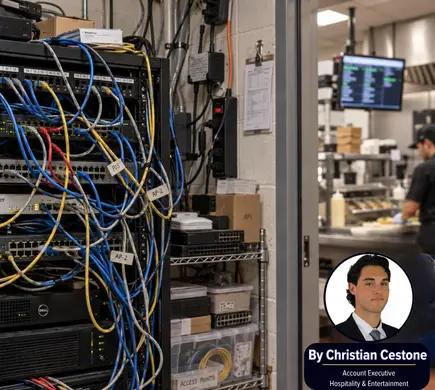
When I walk a location that's about to scale digital, I don't start at the kiosk. I head to the back office.
The rack tells the story. Whether it's been touched since the location opened. Whether there's power and room for one more device. Whether the last three upgrades got installed clean or just got stacked on top of whatever was already there.
Most locations were built for a lighter era. Fewer endpoints. Less real-time demand. Less happening at once. Less pressure at peak. That's not a knock on anyone: location readiness just didn't evolve at the same speed as digital ambition.
And the math catches up at the worst possible time. A kiosk that takes an extra two seconds to load doesn't sound like a problem. Multiply it across a lunch rush, across every location in the fleet, and the longer ticket times. Abandoned orders. A guest who tried the new thing once and went back to the line.
Here’s what that looks like in practice. A restaurant that used to run around 20 connected devices can easily run 35 to 45 today: kiosks, kitchen displays, handhelds, delivery tablets, the Epson receipt printer at the counter, payment devices, all of it. The location didn’t get bigger. The digital load did. And every one of those devices leans on the same network and the same infrastructure behind it.
When the foundation can't carry the new load, the failure isn't dramatic. It's quiet. Orders lag. The KDS falls behind. A kiosk freezes mid-order and the line backs up toward the door. Someone reboots the access point in the back and hopes it holds through the rush.
And it rarely breaks the day you add the device. That’s the tricky part. The load creeps up quietly, one more endpoint and then another, and everything looks fine right up until a peak when it isn’t.
None of this is flashy
It starts with the cabling under the floor and behind the walls. Structured cabling, run clean and run to standard: rough-in to termination to final device turn-up, labeled, tested, and certified to OSHA and BICSI. That's not a line item at the bottom of the quote. It's the foundation everything else rides on: the POS, the network, the kiosks, the displays, the cameras, the Wi-Fi. When the wiring is clean, everything above it has a chance. When it isn't, you feel it at peak. And you feel it everywhere at once.
From there, it's the rest of the unglamorous work. Wi-Fi density planning so the drive-thru lane holds at peak. Segmenting POS traffic from guest and delivery-tablet traffic so a busy lobby doesn't slow the registers. UPS sizing so a brownout doesn't take the KDS down mid-rush. Standardizing the POS image across the fleet so the automation layer lands on the same hardware everywhere not a different setup in every location.
None of it is glamorous. Great tech starts with clean wiring. It's the difference between automation that delivers and automation that becomes one more support ticket.
You can see it building long before it ever causes an outage. At IW Technologies, we’ve staged and wired enough of these builds more than 5 million feet of cable, a thousand-plus rollouts to know the network closet usually tells on a location first. It gets crowded. The switches fill up. The cabling gets harder to manage with every device added. None of it throws an alarm on day one. But as the count climbs, that’s where performance and reliability start to slip.
Build for what you're plugging in
This is where the install quietly earns its keep. New technology only pays off if it goes in clean: staged, imaged, and tested before it ever ships, installed to standard, running on hardware that can scale, with someone keeping the lifecycle straight as devices age and get swapped out. Done right, none of it is visible. The kiosk just works. The drive-thru just moves. That's the point.
I'm not saying slow down on automation. The opposite: add the AI, add the kiosks, automate what you can. Just make sure the foundation under it is ready to carry the weight, because the smartest tool in the building still bends at the weakest part of the floor.
So if you're rolling new tech into your restaurants and venues this year, a few honest questions. Is your network built for peak load with the new endpoints on it, not just the old ones? Is POS traffic segmented from everything else? Are your builds standardized location to location? And is the rack in the back of house ready for what you're about to plug into it?
If you're working through any of this, I'm happy to take a look. Walk me through your back of house, or send me a photo of the rack. I'll tell you straight what I see. No deck. No pitch. Talk soon!